HOMES Solar Installation
HOMES, Inc. is a certified solar installer for both residential and commercial solar projects. With hundreds of panels installed across Letcher, Perry, and Breathitt counties, HOMES is Eastern Kentucky’s premier solar installer. HOMES was even awarded Solar Builder Magazine’s prestigious 2021 Project of the Year Award. Contact us today to speak about the possibilities of Solar installation!
Why Install Solar?
A solar installation on your home or business directly offsets the cost of electricity. Eastern Kentucky’s been subject to three rate hikes in the last five years and it’s projected that electricity costs will continue to rise over the next decade. By installing a solar system you can offset your yearly electrical cost and help protect yourself from any future rate increases. As a homeowner if you have any tax liability at the end of the year you may be eligible for a substantial federal tax credit. For a rough estimate of how much an installation could save you and your business, use our Solar Installation Cost Calculator to the right. In addition, financing may be available at a low fixed-rate interest.
Return on Investment for Your Business
Businesses are hit hard with demand charges that add to the overhead costs of running your business. By installing a solar system you could get under the demand charge and use that money to invest in your business. Financing options may be available for your business or non-profit organization. Your business may also be eligible for grant funds through USDA’s R.E.A.P program, as well as a federal tax credit. For Farmers, you may qualify for an additional grant through KADF’s On-Farm Energy Efficiency Incentives Program that may reduce the cost of your installation by as much as $10,000.
Our Process
To get more information and a quote for your property, fill out the quote form below. Once we receive your information, our Solar Specialist will be in touch to get more details and schedule a visit to your property. Once at your property, we utilize state of the art drone technology to make a virtual model of your roof and analyze the solar generation potential of your property. After this evaluation, HOMES will design a custom system to perfectly suit your needs. Your personalized quote will include cost, projected savings, and a computer rendering of what the solar system looks like right on your roof.
Here at HOMES, we’re not here to just sell you solar, we’re here to inform you so you can make the best choice whether solar is a good fit for you or your business.
How Does Solar Work?
While every system HOMES installs is customized to meet a customer’s individual needs, there are two overall types of solar systems HOMES installs: grid-direct and multimode systems. Both systems take advantage of net metering where any excess power generated by your solar array is automatically sold back to the grid, saving you more money. Grid-direct systems are the most common type of solar array in the United States. These systems have no batteries, lowering the system cost. However, these systems are reliant on the grid to operate and don’t provide power during blackouts. Multimode systems are more expensive to install as they include large capacity batteries in the circuit. Excess power from the solar array first charges the batteries and then any remainder is sold through net metering. These systems can continuously provide power regardless of whether the grid is running. Which type of system HOMES installs is completely dependent on your individual needs and desires.
Q&A
For even more information about HOMES’ solar panel installation, click the button below.


12,000 kW commercial solar installation in Hazard, KY

20,000 kW ground mount solar installation at Buckhorn Children and Family Services

40,000 kW commercial solar installation at HOMES’ office in downtown Whitesburg
We’re excited to announce that Fahe has put together a new case study highlighting HOMES Inc.’s work with solar energy and net-zero housing!
In this case study, you’ll learn more about, how HOMES got started with solar, how we’re using solar and net-zero housing to help address energy costs, and how HOMES is growing our solar program and building local capacity right here in Eastern Kentucky.
We love sharing stories about our work and the impact it can have on our communities!
A big thank you to Fahe for putting this case study together and helping share the HOMES story.
Want to learn more? Check out the full case study with the link below!
A Rural KY Nonprofit is Making Affordable Housing Even More Affordable with Solar
This story was produced by Resource Rural in partnership with Mountain Association.
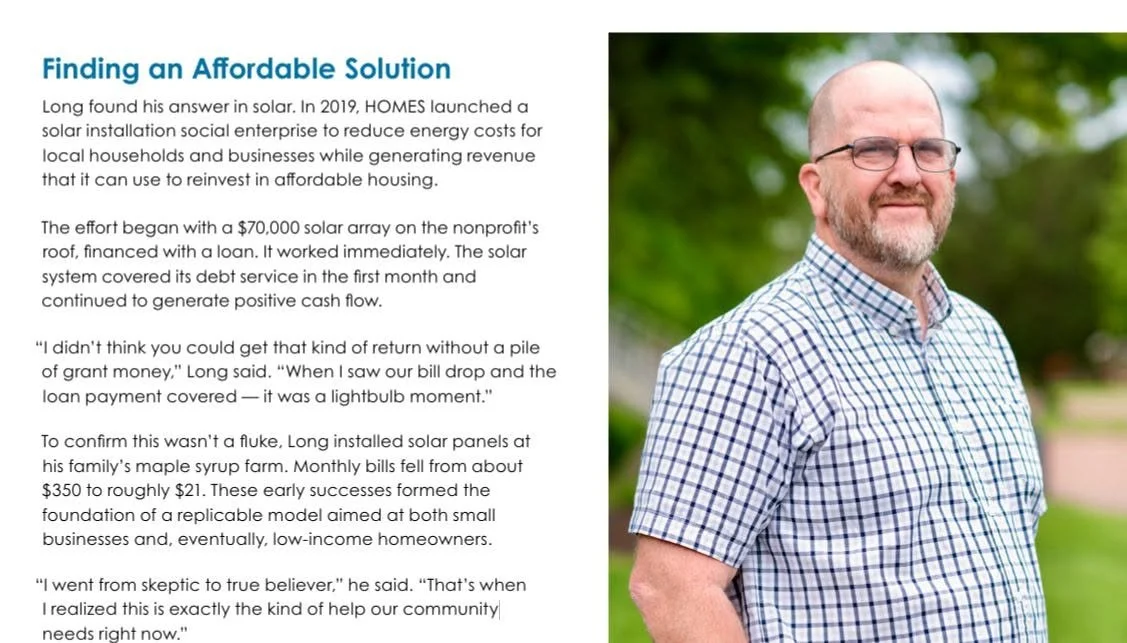
Solar energy wasn’t exactly on Seth Long’s radar, until he really crunched the numbers for HOMES, Inc., the nonprofit housing developer he leads in the rural coalfields of southeastern Kentucky. Whatever skepticism he had all but vanished once he realized the organization would come out ahead, even without a grant or a tax credit.
“The spreadsheets said there was a return on investment if we converted to solar energy,” Long said. “So we did that and immediately it performed even better than what was calculated. I was way ahead with expenses and that kind of opened my eyes.”
Once he realized the potential for energy savings, Long applied for and received a USDA Rural Energy for America Program (REAP) grant to install solar at his farm, which produces maple syrup. And he worked with the Mountain Association, a community economic development organization in eastern Kentucky, to coordinate solar installation training for Clayton “Fuzz” Johnson, an electrician employed by HOMES, Inc.
As a developer of efficient, affordable, high-quality homes primarily for low-income individuals in an area where Long describes the housing market as “broken,” he understood that building homes with solar arrays could greatly reduce the financial burden of homeownership. What good, he wondered, was owning a home if the homeowner couldn’t afford the electric bill?
“This community desperately needs it. We’re in a depressed region and people are trying to get by. So, if we can save people money, that makes sense. We’ve learned something here,” he said of the journey HOMES Inc. took through his own solar curiosity.
Installing solar would expand the HOMES, Inc. service line and reduce the energy burden for the people the organization serves. And by installing the solar themselves, instead of outsourcing it to another company, HOMES Inc. could reduce costs and have more control over the timing of the project.
The cost of training for Johnson was covered by the Partnerships for Opportunity and Workforce and Economic Revitalization initiative, known as POWER. That initiative invests federal workforce development and financial resources into communities that have been negatively impacted by the transition away from coal.
POWER was created by the Obama Administration and has been implemented by several agencies since, including the U.S. Economic Development Administration through the Appalachian Regional Commission (ARC). ARC awarded more than $68 million to 65 projects in October of 2024 alone. Mountain Association’s New Energy Internship, through which Johnson received his training, was funded via POWER.
HOMES Inc. does more than build homes. It also does recovery work, which is where the organization was forced to focus following catastrophic floods that hit the region in 2022. The rebuilding process offered HOMES Inc. a proving ground of sorts to demonstrate the ease with which it was to build a net-zero home if the organization handled the entire project itself — without outside solar contractors.
“It cost $60,000 to get to net-zero traditionally, but we’re demonstrating that you can get there quicker if you have the expertise within your wheelhouse,” he said.
By training that one employee, HOMES Inc. is able to have him oversee solar installation projects, bringing in another source of income for the nonprofit. Right now, Long said the organization is working on a solar project just about every day.
“I call it the solar tsunami. There’s a lot of money coming from the Department of Energy for solar. One of my fears of being on the ground is there’s more money than capable installers. When their Solar for All funding comes down, there won’t be time to ramp up. You can’t build a business for capacity overnight. Now, when that money hits, it’ll be ‘How much can we do?’” Long said.
When Long looks back at the 2022 flooding, he can’t help but appreciate the opportunity it presented HOMES Inc. to illustrate — in practice — how a net-zero home could benefit those living in it.
“In every crisis there is opportunity. Even with the dilemma of the loss of the coal industry, we’re still in the mountains doing energy work, it just looks different today,” he said. “And with the flood, it was a huge crisis but out of it came opportunities to experiment and apply what we’ve learned to affordable housing. That will go a long way.”
The Inflation Reduction Act (IRA), passed by the 117th Congress and signed by President Biden is a piece of federal legislation that aims to reduce inflation by lowering the cost of prescription medications, investing in domestic energy production, and promoting clean energy, among other objectives.
Quisque iaculis facilisis lacinia. Mauris euismod pellentesque tellus sit amet mollis.